Harmelo Registry: Live Canadian & U.S. Governments · Federal · Provincial · State · Municipal
For public housing, government facilities, and program teams

See every public building system. Plan the capital. Show where the money went.

A verifiable, longitudinal record of every system inside public housing, government facilities and civic buildings, from the boiler plant and the switchgear through to the roof, the envelope, the structure and the grounds, built to survive administrations, contractor changes, and program cycles. Facilities teams plan capital on real condition instead of age charts, and the programs that fund building upgrades can see the outcome of that spend, not just that a cheque cleared. You can produce a building's Infrastructure Disclosure Report™ yourself, from records you already hold, before any procurement begins. It groups every system by class, states what evidence sits behind each one, and reports how much of the building is documented separately from how good its condition is.

$150B+
🇨🇦 Canada's Infrastructure Deficit
Canada's infrastructure deficit is estimated at a minimum of $150 billion, with some estimates approaching $1 trillion. Public housing and civic buildings are squarely inside that gap.
Source: University of Toronto School of Cities, 2025
~$100B
🇺🇸 U.S. Public Building Backlog
U.S. states face close to $100 billion in deferred maintenance for publicly owned buildings, with roughly $50 billion more across the federal GSA portfolio alone.
Source: The Pew Charitable Trusts; Public Buildings Reform Board
3-5×
The Cost of Not Knowing
Failure-driven replacement costs several times more than the same work planned in advance. Without lifecycle data, budgets on both sides of the border absorb that premium every cycle.
Source: U.S. Dept. of Energy, reactive vs. planned maintenance
The Stewardship Gap

Public infrastructure runs for decades. Its records rarely survive a single change.

Governments steward building systems across public housing, office buildings, courthouses, schools, and civic assets. The buildings are documented. The financial position is known. But the equipment inside, the part citizens depend on, is governed by records that fragment with every administration, contractor change, and program transition.

Reactive Capital Planning
Budgets built on assumptions
Without lifecycle data, capital budgets rest on age-based depreciation and best guesses. Failures drive spending decisions rather than evidence, and emergency replacement dwarfs planned replacement.
Documentation Resets
History lost at every transition
Records fragment across departments, operators, and contractors. Each procurement change, staff turnover, and program handoff resets the documentation. The institutional memory of the asset is effectively erased.
Governance Exposure
Audits start from scratch
Auditors General, oversight committees, and accountability reviews increasingly demand infrastructure documentation. Fragmented records undermine fiscal defensibility precisely when scrutiny is highest.
The real estate is surveyed. The useful life is modeled. The infrastructure inside is the part nobody can see, and where the capital actually goes.
In the console

The whole portfolio, scored and forecast. Not a binder nobody can find.

Contractors log their work in the field and it flows straight into the record, signed and dated. It stays with the building through every operator change, contractor rotation, and administration, so the record an oversight review draws from is the same one your team plans from. Nothing resets at a transition.
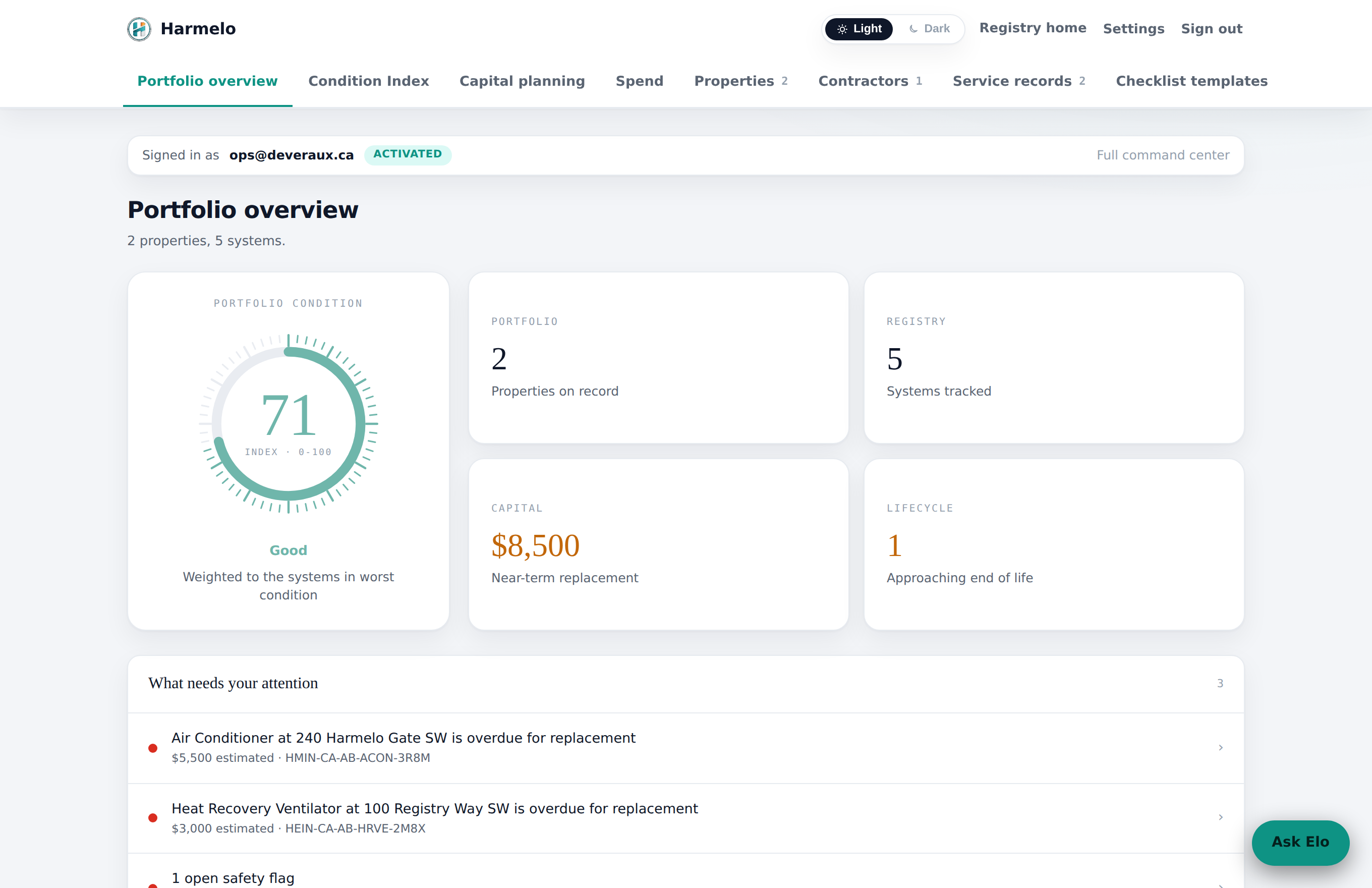
Harmelo portfolio overview showing condition and what needs attention across a housing portfolio

Condition across the portfolio

Every system scored from 0 to 100, with the buildings and systems most at risk surfaced first.
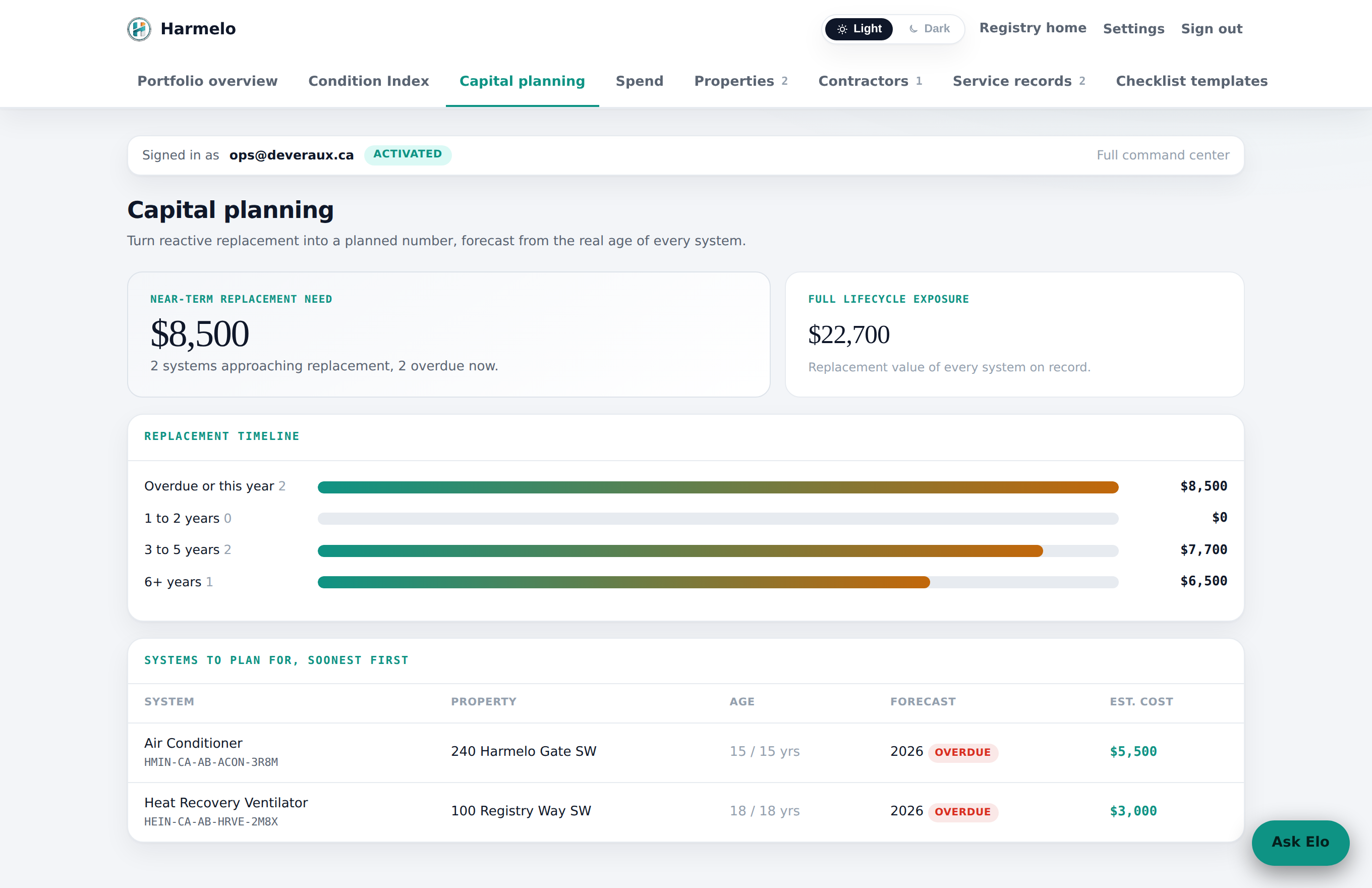
Harmelo capital planning showing forecasted replacements and cost by year

Capital you can defend

Replacement timing and cost forecast by year, so a multi-year plan holds up to a review line by line.

The number underneath the plan

Every capital plan rests on a condition figure. Ask where yours came from.

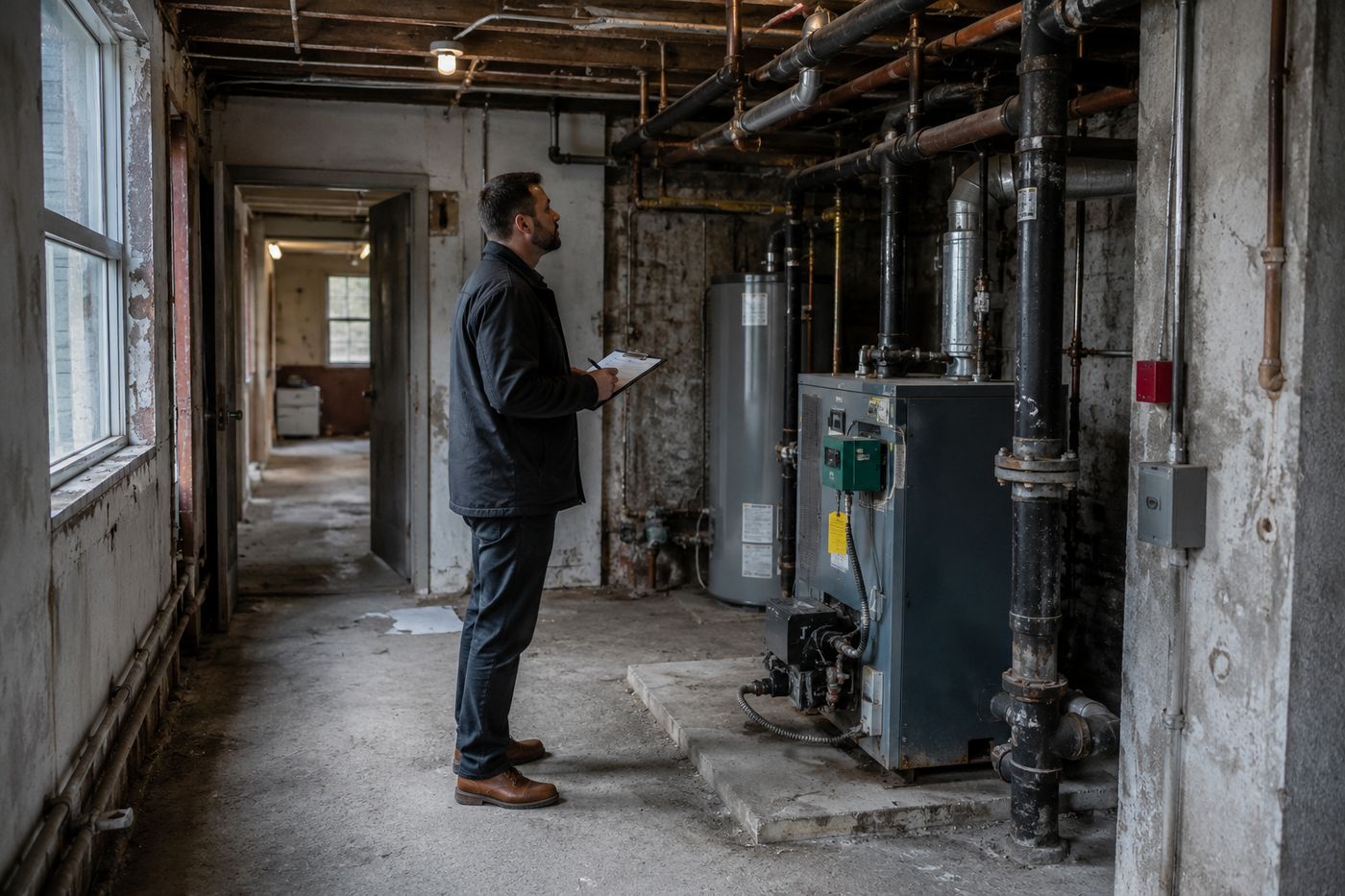
In most portfolios it came from a consultant walking the buildings, once, several years ago, writing down what could be seen from the floor. It was expensive, it was a judgement call, and it was out of date the week it was delivered.

That figure then carries into budgets, board packages and funding submissions, and gets defended in reviews as though it were a measurement. Everybody in the field knows what it actually is. Nothing else has existed.
A documented registry produces that figure continuously, from records your own trades and contractors already generate, with the reasoning behind every point printed underneath it.
A consultant with a clipboard standing in an ageing utility room, assessing a boiler and water heater by eye
One person, one afternoon, once every five years, recording what they can see. Not their fault the figure is soft.
Before you ask

What this does not claim.

A public body has to be able to defend anything it puts in a submission. So here are the limits, stated before anyone asks for them, and every one of them is enforced in the product rather than promised in a meeting.

It is not an inspection.Nobody attended the property. Every figure comes from a document your team supplied or a reading a technician recorded in the field. It says so on every report.
It does not score life safety.Fire suppression, elevators and escalators are a regulated inspection domain with certified trades and statutory intervals. Their documents are held on the record and never assessed or scored.
Coverage is reported separately from condition.A building with two of five categories documented is not comparable to one with five, and a single number would hide that. The report states both.
It says what it knows and how it knows it.Each system carries an evidence level, from held on file through to measured across multiple technician visits. Where an asset has reached the most any record can know about it, the report says so.
The index is not yet validated against outcomes.It is a documented, auditable, evidence-based condition model, and the test of whether low-scoring systems fail sooner requires data still accumulating. We will not describe it as more than that.
It is not a prediction of failure.It describes lifecycle position and documented trend. Where a projection appears it is stated as conditional on the trend continuing, never as a date.

The full methodology, including the change log, the known weaknesses and the corrections still outstanding, is written down and available for review. It is written to be handed to someone who wants to take it apart.

How It Fits Your Stack

It doesn't replace your operations software. It's the record layer beneath it.

Government facilities teams already run operations and maintenance management systems for tenants, work orders, and accounting. Harmelo doesn't compete with those, it sits underneath them as the neutral, persistent identity layer they read from. The two answer different questions.

Category Operations / Management Software Harmelo
Core layer Operations Infrastructure identity
Focus Tenants, leases, accounting Equipment, systems, lifecycle
Data ownership Platform / operator dependent Asset-bound, persistent
Continuity Breaks across changes Survives changes
Role Workflow + management Governance + record layer
Replacement? No, sits underneath your existing system

No rip-and-replace. No new operator workflow. Identity attaches during the install and service activity already happening across your portfolio.

Engagement Packages

One registry. Scaled to your portfolio.

Harmelo engages with governments through models scoped to portfolio size, program priorities, and procurement structure. Audit engagements precede commercial structures, pricing is shaped to the engagement, not pre-set.

Audit
Begin with one region, housing authority, or facility type, and prove value in a defined fiscal window.
Portfolio
Governance-grade intelligence for province, state, and large institutional portfolios.

Every engagement is scoped to your portfolio size, program priorities, and procurement structure, pricing is shaped to the work, not pre-set. The right place to start is a conversation about what your fiscal window and asset base actually need.

Contact us about an engagement →
Use Cases

Built for how governments actually manage infrastructure.

From public housing portfolios to cross-agency coordination, the same registry serves every layer of public stewardship, across Canadian and U.S. governments alike.

Public Housing Portfolios
Capital planning
Track every building system, mechanical and energy through envelope, structure and site, across housing portfolios spanning thousands of units and multiple regions. In Canada alone, federal programs have supported the repair of over 146,000 social-housing units and the maintenance of more than 314,000, exactly the equipment Harmelo registers. Monitor aging systems, forecast capital replacements, and reduce reactive maintenance across the public housing stock.
Government-Owned Buildings
Audit-readiness
Offices, courthouses, schools, and civic facilities. A consistent, audit-grade record of every system that survives staff turnover, departmental restructuring, and political transitions, the same record auditors and oversight bodies draw from.
Multi-Agency Coordination
Shared record
Housing authorities, public works, and energy programs rely on the same underlying equipment data. One registry, accessible across departments and tiers of government, reduces duplicated systems and creates a shared source of truth.
Targeted Incentive Programs
Program delivery
Modernization and electrification incentive programs often deploy outreach and advertising broadly, without granular data on which buildings actually qualify. Geographic and equipment-level data lets governments direct outreach and incentive dollars to the specific regions and assets where upgrades produce the intended outcome, instead of spending program budget on a general audience.
The public case

Public money, you can account for.

Governments answer to taxpayers, auditors, and the administrations that follow, for decisions made on infrastructure that runs long after any single budget cycle. A persistent, verified record strengthens that accountability at every level, and it is the kind of infrastructure that serves a public purpose well beyond any one owner.

Program spending you can measure

Public programs put billions into building upgrades and electrification. A registry lets a funder see the condition and outcome of that spend across the buildings it actually touched, not just that the money went out the door.

A grid you can see coming

As heat pumps, solar, batteries, and EV charging are added to public buildings, HEIN tracks those energy assets, so the load being added to the grid is documented and visible instead of a surprise later.

A made-in-Canada standard

One common record that every level of government, every operator, and every contractor can read the same way, built in Canada, so the way the country's public buildings are documented can be a home-grown standard rather than an import.

Smarter purchasing over time

As the record grows, it shows which equipment actually holds up in the field, so procurement can favour what performs instead of what looked cheapest on paper.

Next Steps

Start with a scoped audit.

You can begin right now, on your own. Take one building, upload the records you already hold, and read the Infrastructure Disclosure Report it produces, before any procurement or commercial conversation. For a broader rollout across a region, housing authority, or facility type, a scoped engagement follows, sized to your portfolio and procurement process within a defined fiscal window.

What Harmelo Is Not

Honest about what we do and don't do.

Harmelo is a registry. It is not a regulatory inspection service, a procurement system, a replacement for existing CMMS or asset management systems, or a substitute for the operational and procurement frameworks public agencies already run.

Permits & municipal compliance

We do not pull permits, contact municipalities about permits, pay for permits, or verify that a permit is on file with the relevant authority. Permit numbers attached to the registry record reflect what your contractor entered, verification with local authorities is the responsibility of the permit-holder.

Inspection, certification & workmanship

We do not perform, supervise, certify, or verify the quality of any work performed. We are not licensed contractors, engineers, building inspectors, or code-compliance auditors. The registry verifies that the contractor signing a record is a real, credentialed, insured tradesperson; the workmanship itself is between the operator and the contractor.

Service, dispatch & warranties

We do not perform, schedule, dispatch, quote, or charge for any service work. We do not issue, manage, transfer, or honor warranties. Manufacturer warranties and labour warranties are issued by the manufacturer or contractor and stay with them. Warranty documents on the record are stored for reference; we don't administer or enforce them.

Regulatory inspections & certifications

Harmelo does not perform, certify, or substitute for any regulated inspection, elevator certifications, fire system inspections, boiler safety inspections, building code compliance reviews, or other inspections required by jurisdiction. The registry captures inspection events as records when entered by authorized contractors; the inspections themselves are performed by licensed inspectors under their own regulatory authority.

Existing systems of record

We do not replace CMMS, ERP, asset management, or other systems of record the agency already operates. The registry sits beneath these systems as a verified source of asset identity and service history; existing operational systems continue to handle workflow, budgeting, and reporting in the formats your teams already use.

Procurement & vendor management

We do not perform procurement, vendor selection, contractor management, or work order administration. The registry verifies the credentials of contractors who sign records on agency assets; procurement processes, vendor evaluation, and contract administration remain within the agency's existing operational and procurement frameworks.

The registry is the record, not a substitute for the professional judgment, regulatory processes, or contractual relationships that govern your work. If something on a record needs to be verified, corrected, or disputed, that conversation happens with the contractor who signed it or the authority responsible for the underlying process. Our role is to keep the record straight, structured, and accessible to the parties who need it.

The household side of the same record

Every home in a jurisdiction can hold its own record directly. A homeowner brings the invoices, permits and warranty papers they already have, and gets a full scored Asset History Report (AHR™) on their house at no cost to them, whether or not anyone else is involved.

That matters to a programme for two reasons. Participation does not depend on a contractor, a utility or a municipality acting first, so coverage can start on day one rather than waiting for an industry to adopt something. And the household keeps a durable record of what was installed and what it cost, which is the evidence a retrofit programme usually has no way to collect after the cheque clears.

Registry access for an organisation, a portfolio or a jurisdiction is a separate arrangement from the household record, and is scoped to the systems and buildings involved.