Building intelligence. Grounded in the work.
One connected system that turns building records and contractor findings into operational and financial decisions. Every screen below is the current product, with demonstration data.
What Harmelo does
Know what needs attention, what it costs and what to plan.
Visits, invoices, contractor findings and plans usually sit with different people. Harmelo connects them for every building and unit, then shows what needs attention, what it is costing, what to repair, replace or fund, and what is changing across the portfolio. Each item links to its source.
How Harmelo keeps each unit's history straight
- Provenance. Every fact shows what it rests on: a signed visit, an accepted document, an import or an engineering assessment.
- Identity. An identifier that is never reused, so one boiler's history never drifts onto its replacement.
- Identifier families. Building identifiers (HBIN) stay with the building through a sale or transfer; equipment identifiers (HMIN for mechanical, HEIN for energy systems) are never reused, so a replacement starts its own history.
- An internal identity system. These are Harmelo record identifiers, not a government, land-title or other official registration, and they do not certify the equipment or the work.
Harmelo identifiers that survive a change of contractor, software or owner. They are internal record identifiers, not an official registration.
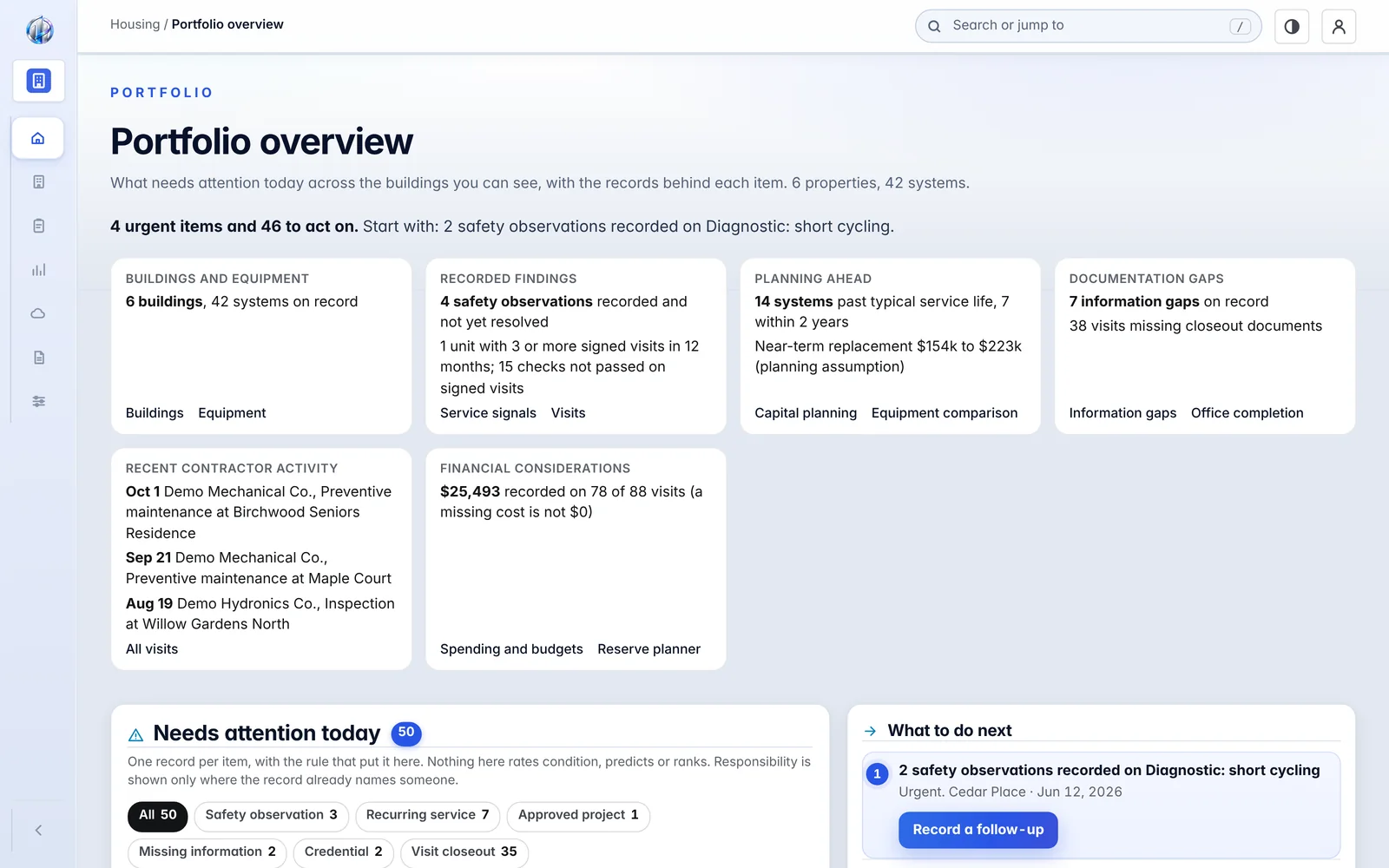
The building and equipment record
Know what is installed, and how you know.
Equipment facts, signed visits, documents, warranty, cost and replacement planning on one record, from installation to today.
- Documented facts are shown differently from planning assumptions.
- Missing information is listed as missing, never as a defect.
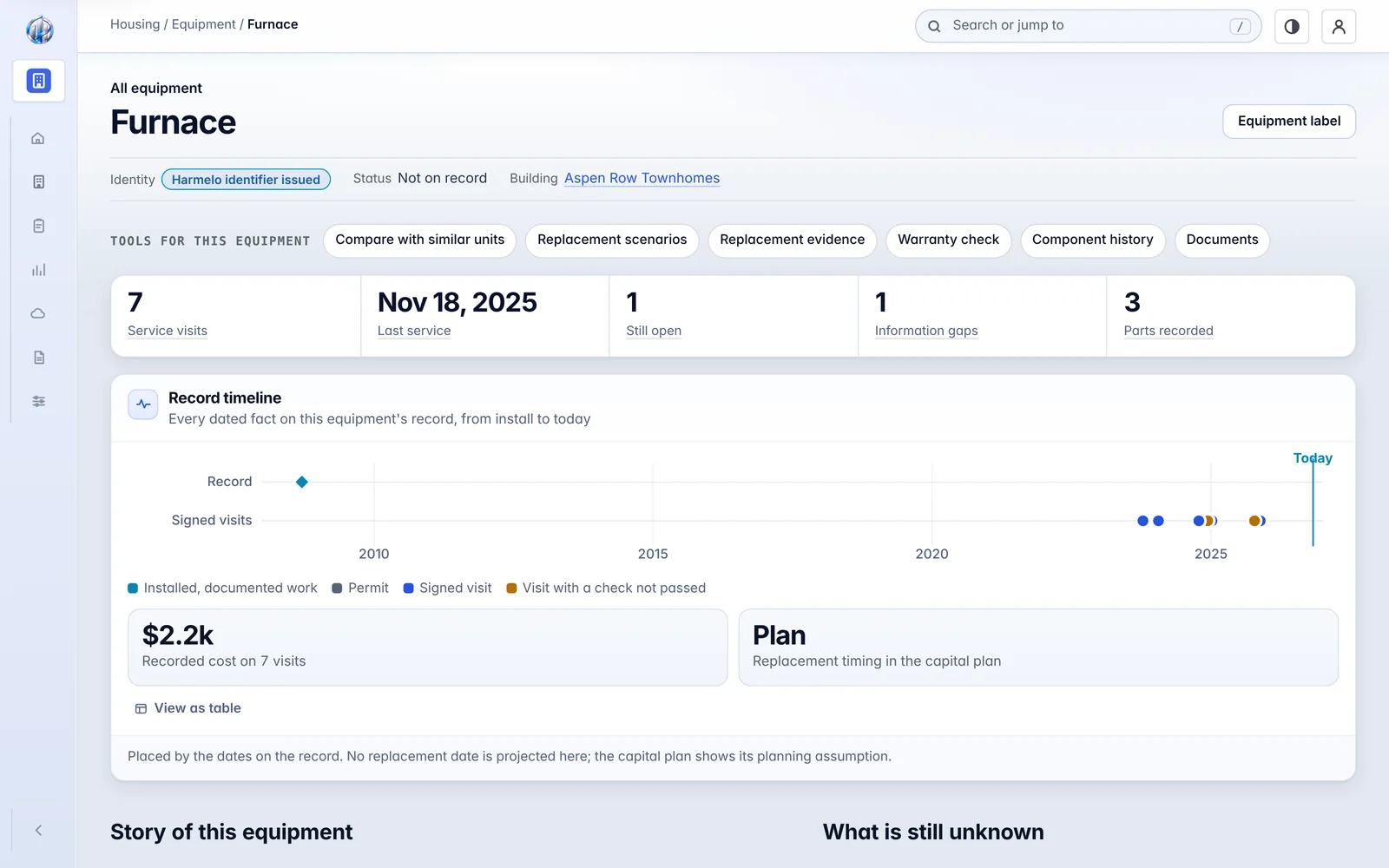
How contractors and operators contribute
Keep the history when contractors or staff change.
Every signed visit is filed against the unit, by the company and technician who did it, so the next technician starts where the last one finished. When a manager, operator or owner changes, the owner can authorize a custody transfer, recorded in Audit. The building history moves with the property; private and internal working notes stay with the organization that wrote them.
- Signed visits with checklists, readings and photos.
- Documents such as invoices, warranties and permits.
- Engineering assessments, kept beside the equipment.
- Imports, marked as entered or imported rather than documented.
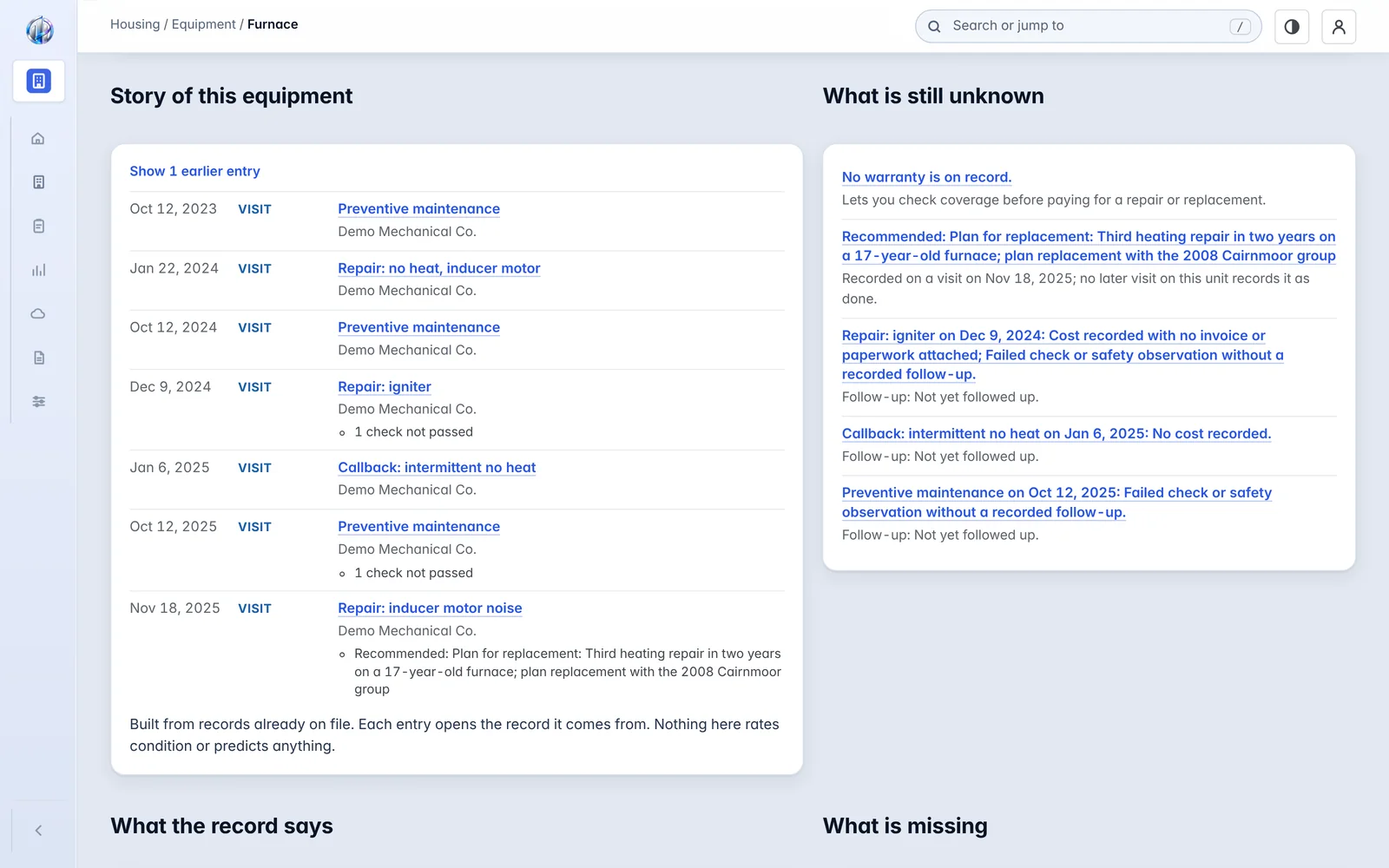
The decisions it supports
Decide what to repair, replace and fund.
Compare service and cost across similar units, with the units and visits behind every figure. See when equipment reaches its typical service life, what replacing it is estimated to cost, and how each building's replacements fall year by year.
Recorded costs and planner estimates are labelled separately. Planning assumptions, not predictions that anything will fail.
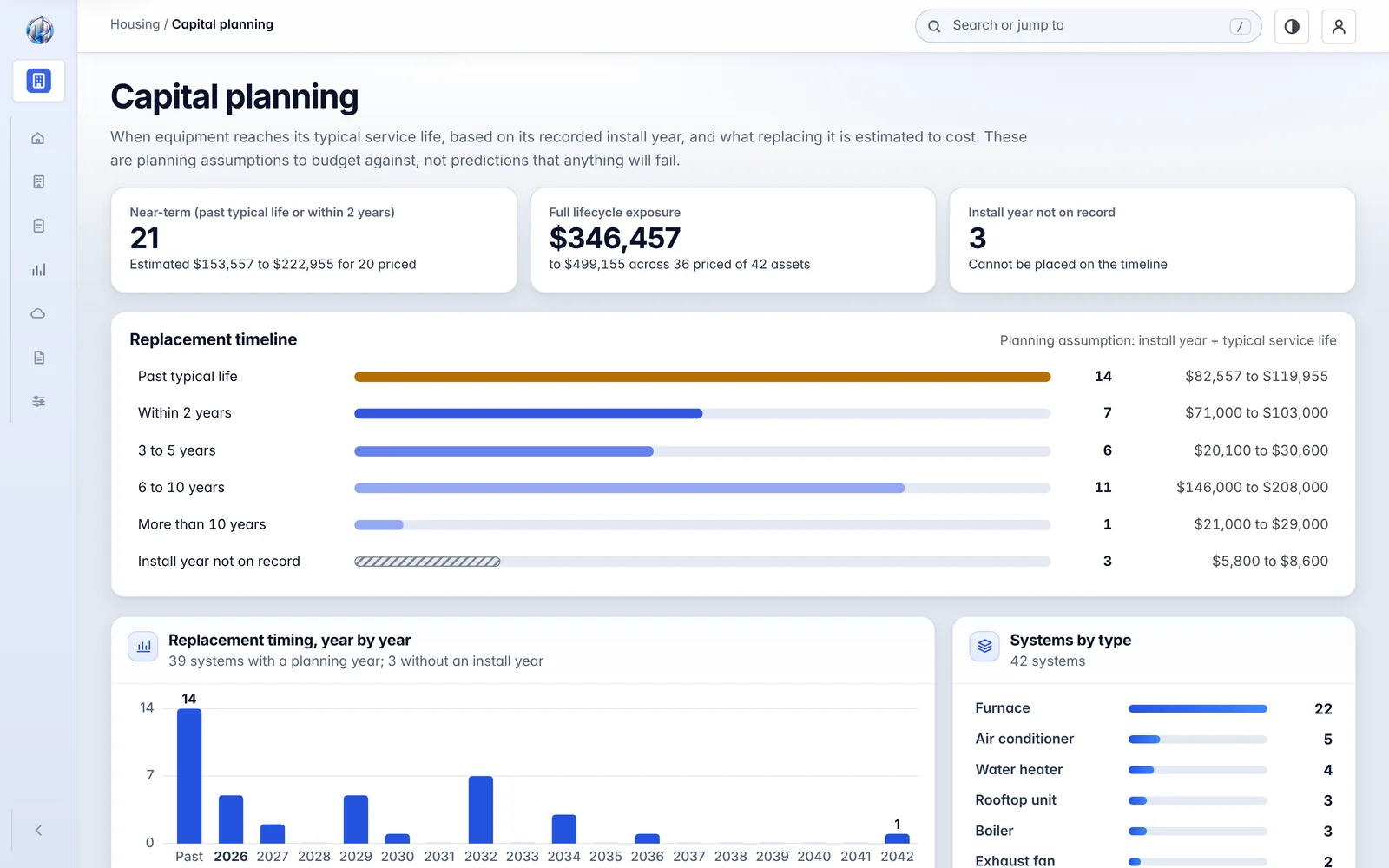
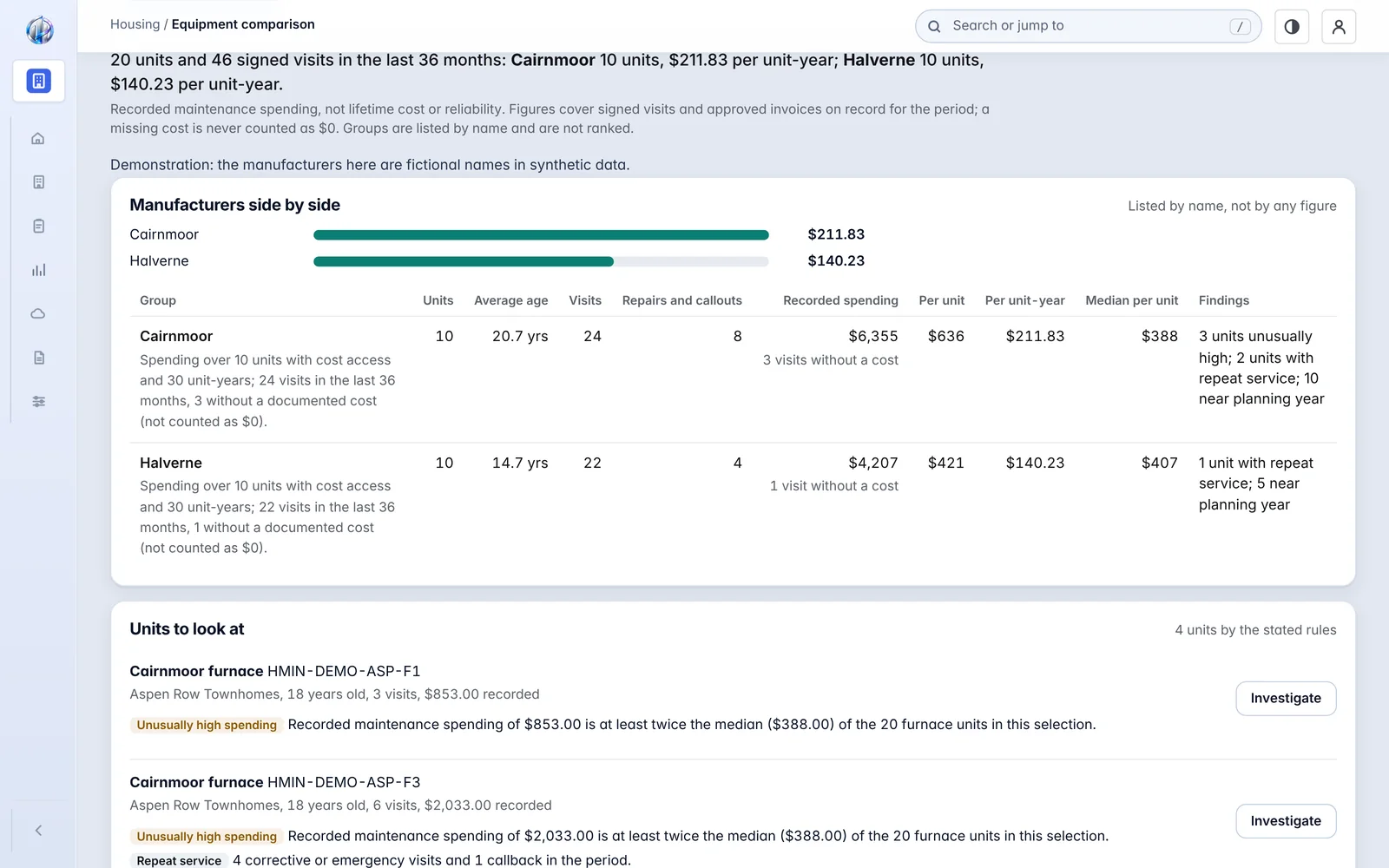
Service and cost
Spending per unit-year, with denominators.
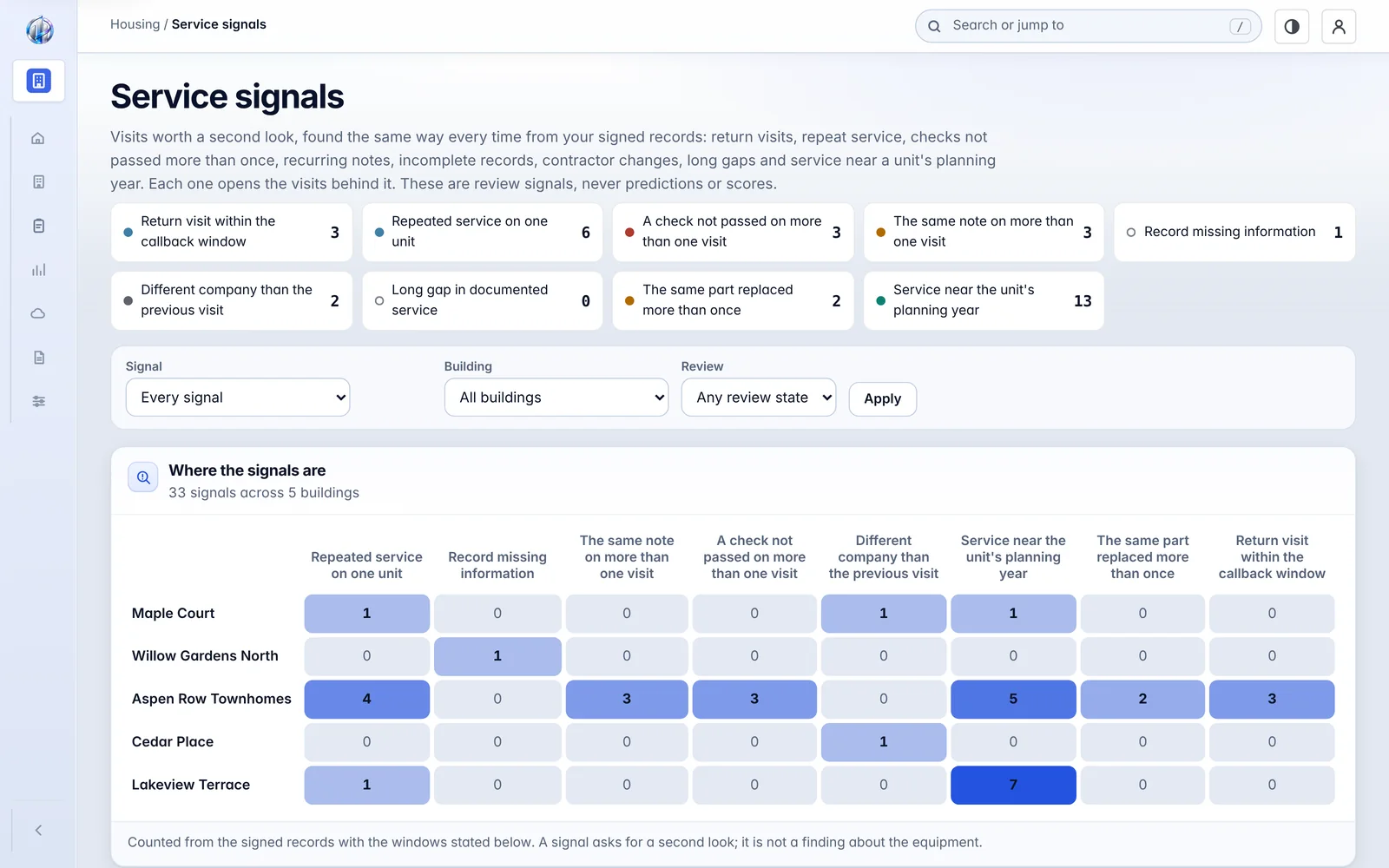
Recurring issues
Repeated findings, by building.
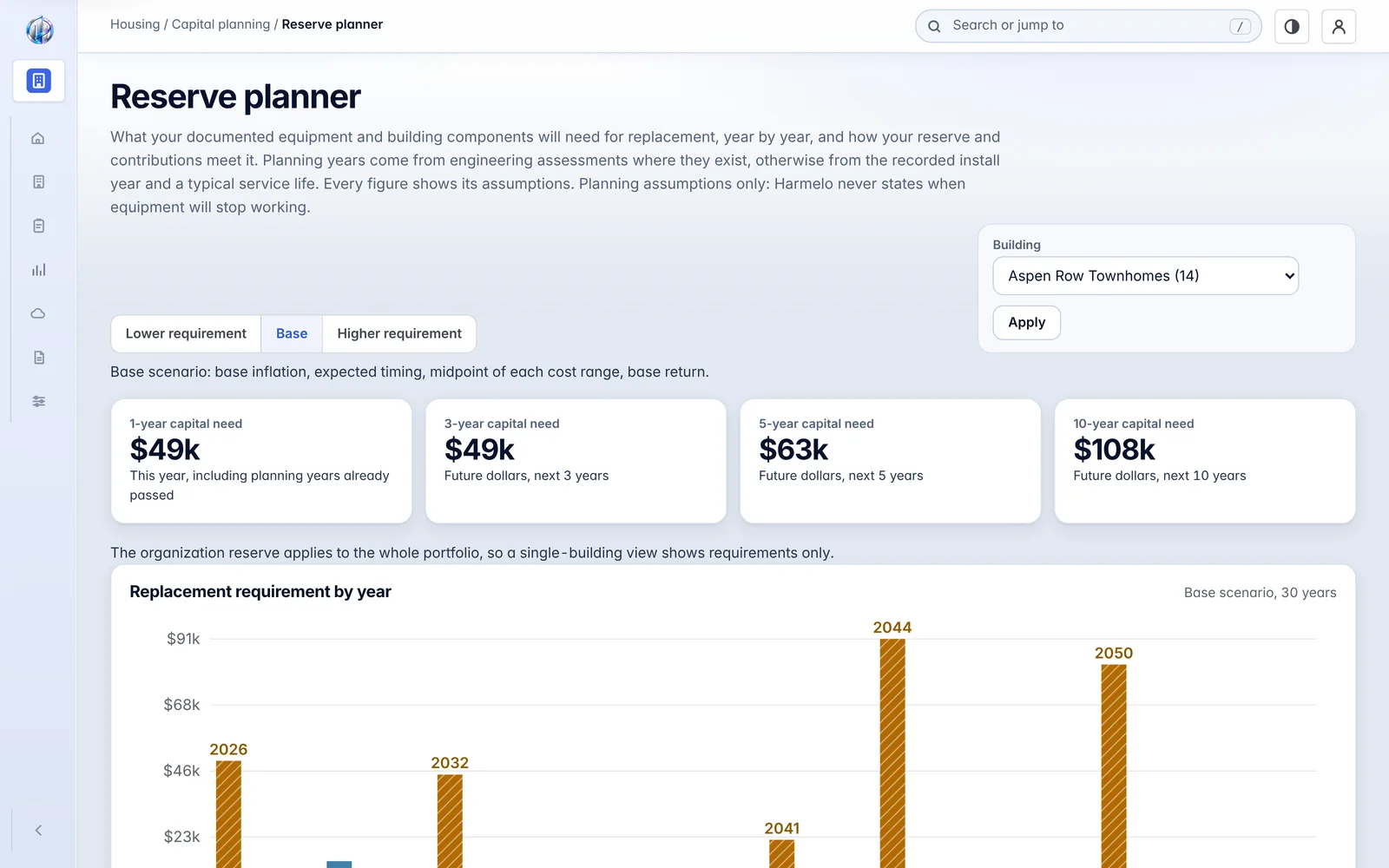
Reserve planner
Each building's replacement need, year by year.
Evidence and control
Every fact shows where it came from.
Facts from visits and paperwork carry their source, and a person accepts them. The organization holding the record decides who reads and writes it.
Outputs: the Infrastructure Disclosure Report and evidence packs
Infrastructure Disclosure Report. One building: equipment, service history, findings, replacements and what is not documented.
Evidence packs. For an insurance renewal, lender review, acquisition or due diligence, with costs shown only where the reader's access includes them. Every statement shows its source. Nothing is a certification, an inspection or a score.
Permissions and audit
- People and roles. Staff get the access their role needs. When they leave, their work stays on the building.
- Contractors you authorize. Access to the equipment you grant, ending when you end it.
- Owner-controlled sharing. The owner decides what moves in a handover or appears in an evidence pack.
- Audit history. Every change to the record, by whom and when.
Handover and custody transfer
Handover review shows what is known, what is missing and what will move. Nothing transfers without the owner's decision. Then the authorized transfer moves the record:
- Propose. You propose the transfer, with a manifest of what moves and what stays.
- Accept. The receiving organization accepts or declines. Only an organization with governed roles and permissions can accept a building.
- Carry out. The record moves with its history and documents. Copies are made before anything is removed.
- Access ends. Your access ends, and both organizations' Audit records every step.
Working notes, other parties' confidential material and contractor access do not transfer. A home connected to an organization stays its owner's.
Works alongside your CMMS and property-management system
Works alongside the systems that run the work.
Your CMMS runs the work order and your property system runs the lease. Harmelo connects what contractors, engineers and staff record about the same building and equipment, and keeps that history through changes of contractor, staff and owner.
Existing records come in by import, marked as imported, not as documented. Harmelo has no public API or live connector to another named product today; connections are scoped with technology partners.
What stays where
Your buildings connect your people. Harmelo connects their knowledge.
Harmelo Network is in development and not live. It is designed to connect operators, maintenance teams and contractors around the buildings and equipment they work with.
Explore Harmelo Network In development. Not yet available in Harmelo accounts.
Put your buildings on record. Build your operating history.
Contractors and builders start with a free account. Organizations start with Free Core, and larger, public and institutional ones are set up with our team. How pricing works